
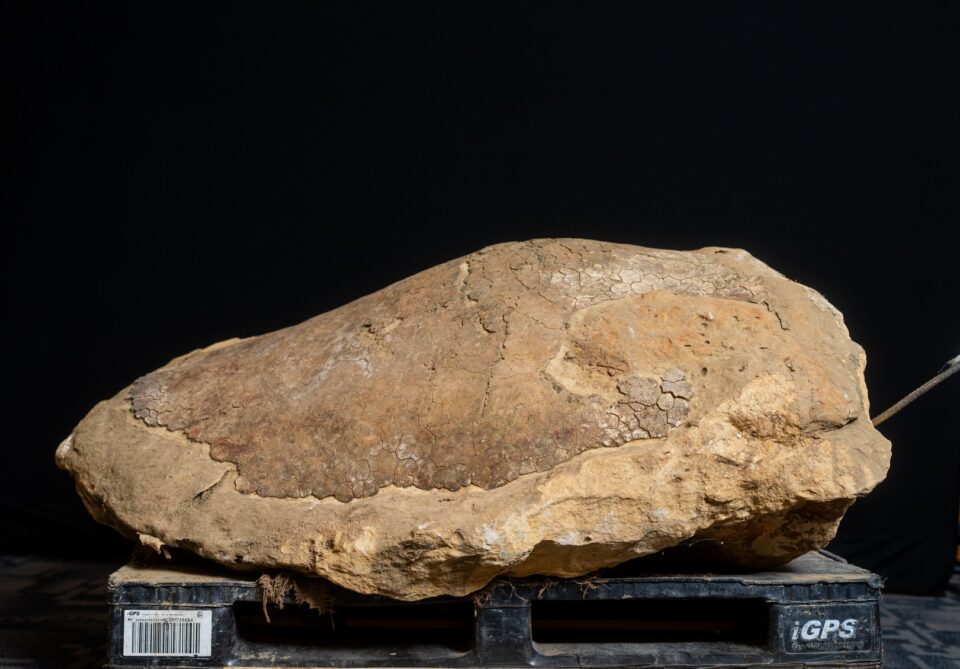
What if your family fishing trip turned into the discovery of a lifetime? That’s what recently happened to the Colemans, an Alabama family of four, while fishing along the river in south Alabama—they discovered the fossilized shell of a 32-million-year-old leatherback sea turtle, approximately 4 feet long and 3 feet across. Not only is it huge and ancient, it’s a new genus and species of leatherback sea turtle. Not to mention, it’s one of the most complete fossils of its kind around the globe. “I’d never seen anything like it,” shares Adrienne Coleman, the mom. “We knew it was probably a fossil but there was no telling what kind.”
They stumbled upon it while fossil hunting, on a break from fishing—the adventurous spirit in Adam Coleman, the dad, inspired from his own childhood. “My dad got me into collecting fossils when I was a kid,” explains Adam. “Now we look for them every time we’re on the river.” Unsure of what exactly they’d uncovered embedded in a giant limestone boulder, the family decided to keep their find a secret for over a year, until Adam read about Dr. Andrew Gentry, a paleontologist located in south Alabama. “When I saw the fossil for the first time, it was hard to believe what I was seeing,” confesses Gentry. “It was absolutely breathtaking.”
Gentry reached out to a colleague at McWane Science Center, and eventually researchers from McWane Science Center, the Geological Survey of Alabama, Dauphin Island Sea Lab, Alabama Aquarium, and the National Oceanic and Atmospheric Administration Corp all collaborated to retrieve the fossil.
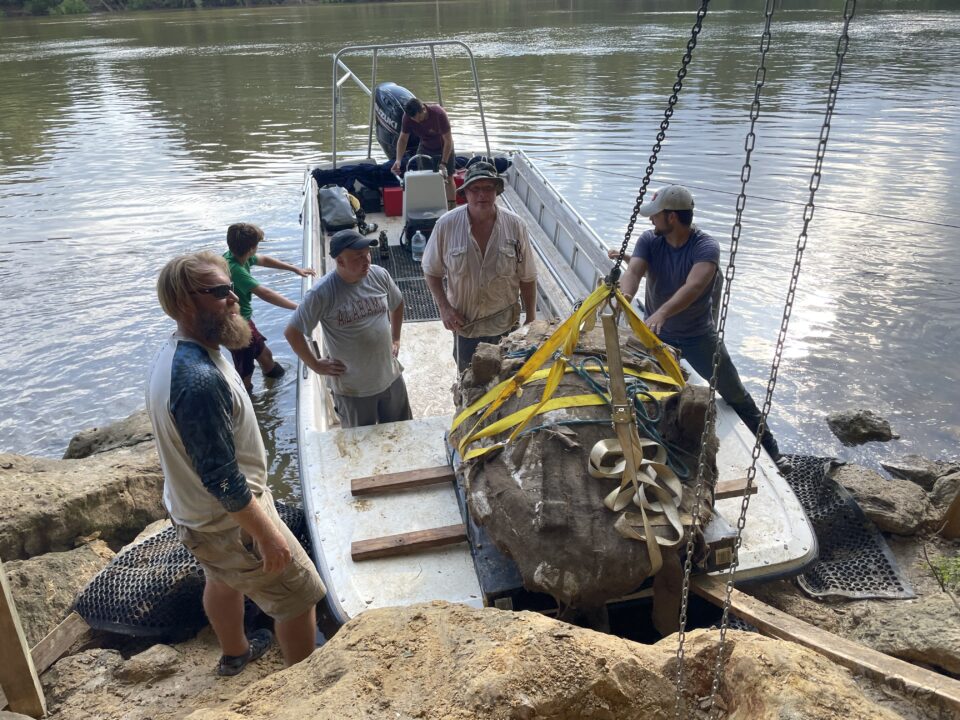
boat. Left to right: Josh Goff, Miller Nama, Jun Ebersole, Corey Harper, Charles Nichols,
Andrew Gentry. Photo by Erik Kizee.
“Who gets to name such a special find?” you may wonder. The new species, Ueloca colemanorum (pronounced “Wee-low-juh kohl-man or-um”) was named by the Poarch Creek Indians Calvin McGhee Cultural Department alongside a team of paleontologists from both Alabama and California. Since the fossil was found in the Creek ancestral homeland, it was decided that this new leatherback turtle should be partly named in the Creek language of the Muscogee (spelled in traditional Creek as “Mvskoke”). The genus name Ueloca (pronounced Wee-low-juh) comes from a combination of the Muscogee words “Uewa” (pronounced Wee-wah), meaning water, and “Locv” (pronounced Low-juh), meaning turtle.
“This is the first fossil to carry a Muscogee name and it’s exciting to see our language recognized in this way. Opportunities like this weave our voice into history and ensure it’s never forgotten,” states Samatha Martin, Creek Language Coordinator for the Poarch Creek Indians. Lest you think the Colemans got left out, note the new species name: “colemanorum.” “This is truly a one-in-a-million fossil,” says Jun Ebersole, paleontologist and the Director of Collections at McWane Science Center. “Specimens like this one are why Alabama is quickly becoming a globally recognized hot-spot for fossil diversity.”
You can see this fossil for yourself at the McWane Science Center, where it is currently on display! To find more information about current displays or to buy your tickets, head to mcwane.org. You can also check out our reel on McWane on our social media.